
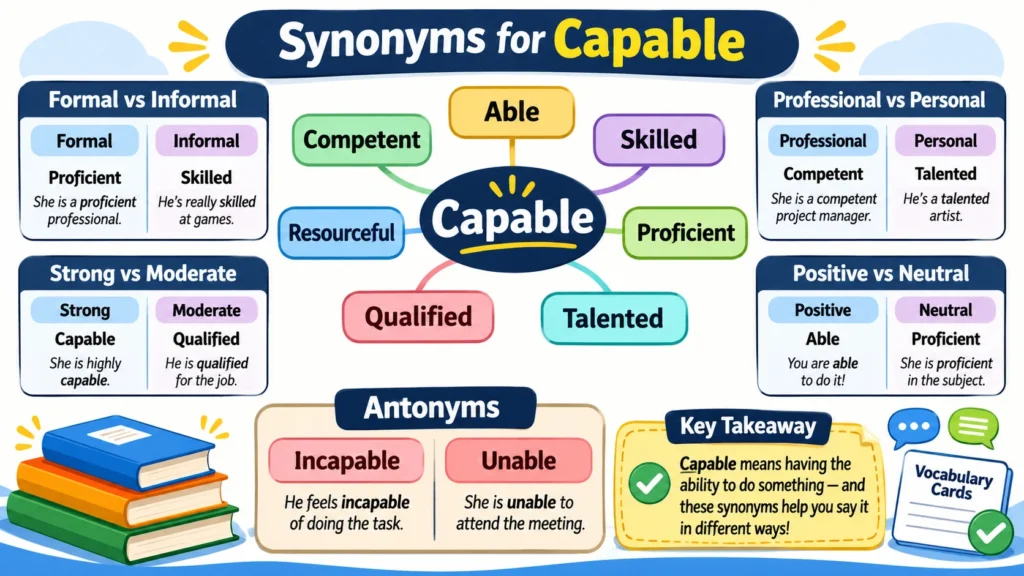
Capable means having the ability, skill, knowledge, or qualities needed to do something successfully. Common synonyms include competent, skilled, qualified, proficient, able, effective, and resourceful. Choose based on whether you mean general ability, professional expertise, or potential.
Have you ever used the word capable several times in the same email, essay, resume, or conversation? It is a useful word, but repeating it can make your writing sound less descriptive than you intend.
Finding the right synonyms for capable helps you communicate someone’s skills, confidence, experience, and potential more precisely. For example, a person might be competent at a task, skilled in a particular field, qualified for a position, or resourceful when solving unexpected problems.
Although these words share a connection with ability, they do not all mean exactly the same thing. The best choice depends on what someone can do and the impression you want to create.
This guide explores their meanings, differences, examples, and best uses in everyday and professional English.
Meaning, Tone and Context
The word capable describes someone or something that has the ability, knowledge, skill, or qualities required to perform a task or achieve a result.
It can refer to present ability or the potential to do something in the future.
Simple definition: Having the ability or qualities needed to do something.
Part of speech: Adjective.
Tone: Generally positive or neutral. It often expresses confidence in someone’s abilities.
Formality: Neutral and suitable for casual conversations, professional communication, academic writing, and formal documents.
Common use cases:
- Describing someone’s professional skills.
- Discussing whether a person can complete a task.
- Highlighting someone’s potential.
- Evaluating performance or competence.
- Describing an organization, system, or machine’s abilities.
- Expressing confidence in someone’s judgment.
Related word forms:
| Word | Part of Speech | Meaning |
| Capable | Adjective | Having the ability to do something |
| Capability | Noun | The ability or power to perform something |
| Capably | Adverb | In a competent or effective way |
| Incapable | Adjective | Lacking the ability to do something |
| Capability development | Noun phrase | The process of improving someone’s abilities |
Example: She is capable of managing a large team.
This means she has the necessary skills and qualities to lead and organize a group successfully.
When and How to Use “Capable”
Use capable when you want to describe someone’s ability, potential, or readiness to handle a responsibility.
It works particularly well when you want to express confidence without making an exaggerated claim.
Here are seven realistic examples:
1. Professional: Daniel is capable of managing multiple projects at once.
Use this when discussing someone’s ability to handle workplace responsibilities.
2. Academic: The student is capable of understanding complex scientific concepts.
This describes someone’s learning ability and intellectual potential.
3. Personal: I know you are capable of making the right decision.
This expresses confidence and encouragement.
4. Resume: A capable administrator with strong organizational skills and attention to detail.
This highlights professional ability in a career summary.
5. Email: Our team is capable of completing the project before the deadline.
This communicates confidence in a team’s performance.
6. Creative writing: She was a capable leader who remained calm during difficult moments.
This gives readers an idea of someone’s character and leadership qualities.
7. Social media: You are capable of more than you realize.
This makes a positive and encouraging caption.
Another Word for “Capable”
The best single replacement for capable is usually competent when describing someone who has the ability to perform a task successfully.
However, the most accurate synonym depends on the situation.
Here are useful alternatives by context:
| Situation | Best Alternative | Example |
| Professional writing | Competent | She is a competent manager. |
| Academic writing | Proficient | He is proficient in statistical analysis. |
| Casual conversation | Able | You are more than able to handle it. |
| Emotional writing | Strong | You are strong enough to face this challenge. |
| Creative writing | Resourceful | She is a resourceful problem solver. |
| Resume writing | Skilled | Skilled professional with leadership experience. |
| Social media captions | Talented | You are talented enough to make it happen. |
| Stronger meaning | Accomplished | She is an accomplished researcher. |
| Softer meaning | Promising | He is a promising young designer. |
Best recommendation: Use competent when you mean someone can perform a task reliably. Choose skilled when you want to highlight practical expertise and proficient when you mean someone has developed a high level of ability.
When Not to Use “Capable”
Although capable is versatile, it can sometimes sound too general. It tells readers that someone can do something, but it does not always explain what makes that person effective.
Consider these situations:
1. When you need to highlight a specific skill
Instead of: She is capable of designing websites.
Better: She is skilled in website design.
The second sentence identifies the actual expertise.
2. When describing professional qualifications
Instead of: He is capable of applying for the position.
Better: He is qualified for the position.
Qualified suggests that someone meets the required standards or credentials.
3. When describing advanced expertise
Instead of: She is capable in data analysis.
Better: She is proficient in data analysis.
Proficient communicates developed knowledge and practical ability.
4. When you want to emphasize achievement
Instead of: He is a capable entrepreneur.
Better: He is an accomplished entrepreneur.
Accomplished highlights demonstrated success rather than ability alone.
5. When describing someone who solves problems independently
Instead of: She is capable of handling unexpected problems.
Better: She is resourceful when handling unexpected problems.
Resourceful emphasizes creativity and the ability to find solutions.
Words Commonly Confused With “Capable”
Some words are closely related to capable, but their meanings are not interchangeable in every sentence.
| Word | Difference From Capable | Example |
| Competent | Emphasizes having enough ability to perform a task properly | He is a competent supervisor. |
| Qualified | Emphasizes meeting specific requirements or possessing credentials | She is qualified to teach mathematics. |
| Skilled | Highlights developed ability gained through practice or experience | He is skilled at negotiating. |
| Proficient | Suggests a strong or advanced level of ability | She is proficient in Spanish. |
| Talented | Often suggests natural ability or a special aptitude | He is a talented musician. |
| Effective | Focuses on producing the intended result | She is an effective communicator. |
Remember: A capable person has the ability to do something, while a qualified person meets specific requirements. Someone can also be talented without having the professional experience needed for a particular role.
Best Synonym by Context for “Capable”
The best synonym depends on what you want readers to understand. A resume may require a word that demonstrates expertise, while an encouraging message may need something warmer.
| Context | Best Synonym | Why It Works | Example |
| Formal writing | Competent | Sounds professional and reliable | She is a competent department head. |
| Academic writing | Proficient | Highlights developed knowledge | The researcher is proficient in data analysis. |
| Professional communication | Effective | Emphasizes successful performance | He is an effective team leader. |
| Resume writing | Skilled | Highlights practical expertise | Skilled project coordinator with five years of experience. |
| Casual conversation | Able | Sounds natural and simple | You are able to handle this. |
| Creative writing | Resourceful | Suggests cleverness and adaptability | The resourceful explorer found a way home. |
| Emotional writing | Strong | Adds confidence and encouragement | You are strong enough to overcome this. |
| Strong ability | Accomplished | Suggests proven success and achievement | She is an accomplished public speaker. |
| Moderate ability | Competent | Communicates dependable performance | He is a competent employee. |
| Social media captions | Talented | Feels positive and expressive | Talented, focused, and ready for anything. |
| Leadership | Dependable | Emphasizes trustworthiness and consistency | She is a dependable leader. |
| Technical skills | Proficient | Highlights practical technical knowledge | He is proficient in software development. |
| Creative projects | Gifted | Suggests exceptional natural ability | She is a gifted artist. |
| Problem solving | Resourceful | Highlights finding solutions | He is resourceful under pressure. |
| UK and US English | Able | Common and natural in both varieties | She is able to complete the assignment. |
Which Synonym Should You Choose?
Choosing a synonym is not simply about finding another word with a similar dictionary definition. You should consider what kind of ability you want to describe.
Use this practical decision guide:
1. Think about the exact meaning.
Are you describing general ability, professional knowledge, natural talent, or proven achievement?
- General ability: Able
- Professional competence: Competent
- Practical expertise: Skilled
- Advanced knowledge: Proficient
- Natural ability: Talented
2. Consider the level of formality.
For reports, resumes, and workplace communication, competent, proficient, and qualified are usually appropriate.
For casual conversations, able, talented, and resourceful may sound more natural.
3. Consider the emotional tone.
If you are encouraging someone, strong or talented may feel warmer than competent.
If you are evaluating performance, competent or effective may sound more objective.
4. Avoid exaggerating someone’s abilities.
Calling someone accomplished suggests a record of achievement. Calling someone gifted suggests exceptional natural talent.
Do not use these words when you only mean that someone can perform an ordinary task.
5. Match the synonym to the sentence.
Read the complete sentence after replacing capable. If the meaning changes or the sentence sounds unnatural, choose a different alternative.
Real Life Examples of “Capable” in Sentences
Here are practical examples showing how similar words can make everyday and professional writing more specific.
School: Maria is proficient in mathematics and consistently performs well in advanced classes.
Workplace: Our new supervisor is competent and handles daily responsibilities efficiently.
Writing: The author is skilled at explaining difficult ideas in simple language.
Conversation: You are more than able to finish this assignment on your own.
Social media: Talented people keep learning, growing, and creating new opportunities.
Resume: Accomplished marketing professional with experience in campaign development and team leadership.
Email: We have a qualified team ready to manage the proposed project.
Storytelling: Despite the difficult circumstances, the resourceful traveler found a safe place to stay.
These examples demonstrate why selecting the right synonym can make a sentence more informative and memorable.
25 Synonyms for “Capable”
The following 25 words are useful alternatives to capable. Some are close synonyms, while others describe particular kinds of ability, such as professional expertise, natural talent, or successful performance.
| Synonym | Simple Meaning | Best Used For | Example Sentence |
| 1. Able | Having the power or opportunity to do something | General ability | She is able to complete the assignment independently. |
| 2. Competent | Having enough skill or knowledge to do something properly | Professional settings | He is a competent office manager. |
| 3. Skilled | Having developed ability through training or practice | Practical expertise | She is a skilled graphic designer. |
| 4. Proficient | Having a high level of knowledge or ability | Academic and technical contexts | He is proficient in computer programming. |
| 5. Qualified | Having the necessary training, credentials, or requirements | Employment and professional roles | She is qualified to lead the department. |
| 6. Talented | Having a natural or developed ability | Creative and personal contexts | He is a talented photographer. |
| 7. Accomplished | Having achieved a high level of success | Professional achievements | She is an accomplished businesswoman. |
| 8. Effective | Producing the desired result | Workplace performance | He is an effective communicator. |
| 9. Efficient | Completing tasks with little wasted time or effort | Productivity | She is an efficient project coordinator. |
| 10. Resourceful | Finding clever ways to solve problems | Adaptability | The resourceful employee found a practical solution. |
| 11. Competent | Able to perform tasks reliably | Everyday and professional use | We need a competent person to manage the schedule. |
| 12. Adaptable | Able to adjust to new conditions | Changing environments | He is adaptable and learns new systems quickly. |
| 13. Versatile | Able to perform different tasks or fulfill different roles | Multiple skills | She is a versatile designer and writer. |
| 14. Proficient | Skilled through knowledge and experience | Specialized abilities | The technician is proficient in network maintenance. |
| 15. Gifted | Naturally talented or exceptionally able | Creative and academic contexts | She is a gifted young musician. |
| 16. Accomplished | Highly successful in a particular field | Achievement focused writing | He is an accomplished public speaker. |
| 17. Dependable | Able to be trusted to do what is expected | Personal and professional reliability | We have a dependable employee on the team. |
| 18. Reliable | Consistently performing as expected | Workplace and everyday use | She is a reliable person to work with. |
| 19. Adept | Very skilled at doing something | Formal and professional writing | He is adept at handling difficult negotiations. |
| 20. Apt | Naturally suited or quick to learn something | Learning and aptitude | She is an apt student who understands new ideas quickly. |
| 21. Empowered | Given the authority or confidence to act | Leadership and personal development | The team feels empowered to make decisions. |
| 22. Strong | Having the ability or resilience to manage challenges | Emotional and personal contexts | He is strong enough to handle the responsibility. |
| 23. Proactive | Taking action before problems arise | Workplace and leadership | She is a proactive employee who anticipates challenges. |
| 24. Enterprising | Showing initiative and willingness to take action | Business and entrepreneurship | He is an enterprising young business owner. |
| 25. Well equipped | Having the necessary resources, knowledge, or skills | Practical readiness | The team is well equipped to handle the new project. |
Accuracy note: Competent, skilled, able, and adept are close alternatives in many contexts. Words such as dependable, proactive, empowered, and well equipped describe related qualities rather than being direct replacements in every sentence. Repeated terms such as competent, proficient, and accomplished have different nuances, but should not be counted as additional unique synonyms in a strict vocabulary list.
Synonym Groups and Usage Differences
Professional vs. Personal Synonyms
Professional writing often requires words that demonstrate knowledge, reliability, and practical performance.
Useful professional alternatives include:
- Competent: Able to perform responsibilities properly.
- Proficient: Having developed expertise in a particular area.
- Qualified: Meeting the requirements for a role.
- Effective: Producing good results.
- Dependable: Consistently doing what is expected.
Personal communication can use warmer and more encouraging alternatives.
For example, talented, strong, able, and resourceful can express confidence in someone’s potential without sounding like a performance review.
Formal vs. Conversational Synonyms
Formal alternatives are useful in business reports, academic essays, professional emails, and presentations.
| Formal or Neutral | Conversational | Example |
| Competent | Able | She is able to manage the task. |
| Proficient | Skilled | He is skilled at editing videos. |
| Qualified | Ready | She is ready for the position. |
| Accomplished | Talented | He is a talented musician. |
| Adept | Good at | She is good at solving problems. |
Conversational expressions are usually easier to understand, while formal words can communicate more specific professional qualities.
Academic Synonyms
Academic writing benefits from accurate words that explain someone’s knowledge or ability without exaggeration.
Consider these alternatives:
Proficient: Suitable for describing a developed level of skill.
Example: The participants were proficient in using the research software.
Competent: Useful when describing sufficient knowledge or ability.
Example: Students should become competent in evaluating academic sources.
Adept: Appropriate when describing someone who demonstrates considerable skill.
Example: The researcher was adept at interpreting complex statistical findings.
Qualified: Useful when discussing credentials or required expertise.
Example: Only qualified professionals should conduct the assessment.
For academic work, choose a word that accurately reflects the evidence. Do not describe someone as accomplished or gifted unless the context supports that judgment.
Professional and Business Synonyms
In workplace communication, capable can sometimes sound too broad. A more specific word can explain why someone is suitable for a responsibility.
| Workplace Situation | Recommended Word | Example |
| Hiring decisions | Qualified | We are looking for a qualified candidate. |
| Performance reviews | Competent | She is a competent employee. |
| Technical expertise | Proficient | He is proficient in data management. |
| Leadership | Effective | She is an effective team leader. |
| Problem solving | Resourceful | He is resourceful when challenges arise. |
| Productivity | Efficient | The department is efficient and well organized. |
| Adaptability | Versatile | She is a versatile member of the team. |
Resume tip: Instead of writing “I am a capable employee,” describe a specific skill or achievement. For example, “Skilled in coordinating projects, managing schedules, and supporting cross functional teams” gives employers more useful information.
Creative or Literary Synonyms
Creative writing often needs words that reveal personality, character, and behavior.
These alternatives can make descriptions more expressive:
- Gifted: Suggests exceptional natural ability.
- Resourceful: Shows creativity when solving problems.
- Versatile: Describes someone with several different abilities.
- Adept: Suggests impressive skill.
- Enterprising: Describes someone who takes initiative.
- Talented: Highlights a special ability.
Example:
Instead of writing, “The capable young artist completed the difficult painting,” try:
“The gifted young artist transformed an ordinary canvas into something extraordinary.”
The second sentence gives the description more personality and visual impact.
Slang or Modern Synonyms
There is no single slang word that directly replaces capable in every situation. However, several informal expressions can communicate a similar idea.
| Informal Expression | Meaning | Example |
| Good at it | Having the ability to do something well | She’s really good at coding. |
| Got this | Feeling confident about handling something | Don’t worry, I’ve got this. |
| On top of it | Managing responsibilities effectively | He’s always on top of his work. |
| Knows their stuff | Having strong knowledge or expertise | She definitely knows her stuff. |
| A natural | Having an effortless or impressive ability | He’s a natural at public speaking. |
These expressions work well in texts, friendly conversations, and informal captions.
Avoid using them in academic essays, formal reports, or professional documents unless the tone specifically allows casual language.
Strongest vs. Weaker Synonyms
Not every synonym communicates the same level of ability. Some suggest basic competence, while others imply exceptional skill or proven success.
Here is a practical scale:
| Level | Word | Meaning |
| Basic | Able | Has the ability to do something |
| Moderate | Competent | Can perform a task properly |
| Reliable | Dependable | Can be trusted to handle responsibilities |
| Skilled | Skilled | Has developed practical expertise |
| Advanced | Proficient | Demonstrates a high level of ability |
| Highly skilled | Adept | Handles a particular activity very well |
| Exceptional | Gifted | Shows outstanding natural ability |
| Achievement focused | Accomplished | Has demonstrated considerable success |
This is a general guide rather than a fixed ranking. For example, qualified describes meeting requirements, not necessarily having greater ability than someone who is merely competent.
Emotional vs. Neutral Synonyms
Some synonyms describe ability objectively, while others add encouragement, admiration, or confidence.
Neutral alternatives:
- Able
- Competent
- Qualified
- Proficient
- Effective
These words are useful when discussing skills, work performance, and practical responsibilities.
More expressive alternatives:
- Talented
- Gifted
- Strong
- Accomplished
- Resourceful
These words can communicate admiration, encouragement, and appreciation.
For example, “You are competent enough to handle the task” sounds like an assessment.
“You are stronger and more talented than you realize” sounds more personal and encouraging.
Antonyms of “Capable”
Antonyms describe an inability, lack of skill, or difficulty performing a particular task. The most accurate opposite depends on the sentence.
| Antonym | Meaning | Example Sentence |
| 1. Incapable | Unable to do something | He was incapable of completing the task alone. |
| 2. Unable | Not having the ability to do something | She was unable to attend the meeting. |
| 3. Incompetent | Lacking the necessary ability or skill | The report identified an incompetent supervisor. |
| 4. Unskilled | Lacking specialized training or skill | The position is suitable for unskilled workers. |
| 5. Inept | Lacking skill or judgment | His inept handling of the situation caused confusion. |
| 6. Unqualified | Not having the required qualifications | She was unqualified for the technical position. |
| 7. Inexperienced | Lacking practical experience | The inexperienced assistant needed additional guidance. |
| 8. Ineffective | Failing to produce the intended result | Their ineffective strategy wasted valuable time. |
| 9. Inefficient | Wasting time, effort, or resources | The inefficient process slowed production. |
| 10. Powerless | Lacking the power or control to act | The residents felt powerless to change the decision. |
| 11. Helpless | Unable to manage or improve a situation | He felt helpless during the emergency. |
| 12. Unprepared | Not ready to perform a task | The team was unprepared for the presentation. |
| 13. Inadequate | Not good enough for a particular purpose | Her training was inadequate for the role. |
| 14. Clumsy | Lacking physical skill or coordination | He was clumsy when handling the equipment. |
| 15. Ineffectual | Not producing the desired effect | Their ineffectual response failed to solve the problem. |
Important distinction: Incapable and unable are the closest opposites of capable when discussing general ability. Other words describe particular weaknesses, such as poor judgment, insufficient training, or ineffective performance.
Comparison: Capable vs. Similar Words
Understanding the differences between related words helps you choose the most accurate expression.
Capable vs. Competent
Main difference: Capable describes having the ability to do something. Competent emphasizes having sufficient knowledge or skill to perform it properly.
Stronger word: Competent can suggest demonstrated practical ability, while capable may describe potential.
More formal word: Both are appropriate in professional writing. Competent often sounds more evaluative.
Examples:
- Capable: She is capable of managing the department.
- Competent: She is a competent department manager.
Capable vs. Skilled
Main difference: Capable refers to general ability, while skilled highlights developed expertise.
Stronger word: Skilled is more specific about practical ability.
More formal word: Both work in professional communication, but skilled is particularly useful in resumes and job descriptions.
Examples:
- Capable: He is capable of repairing the computer.
- Skilled: He is skilled at computer repairs.
Capable vs. Qualified
Main difference: Capable means having the ability to perform a task. Qualified means meeting the required standards, training, or credentials.
Stronger word: Qualified is more specific when formal requirements matter.
More formal word: Qualified is especially common in recruitment and professional documents.
Examples:
- Capable: She is capable of teaching the course.
- Qualified: She is qualified to teach the course.
Capable vs. Proficient
Main difference: Capable suggests general ability, while proficient indicates a well developed level of skill.
Stronger word: Proficient generally communicates more advanced expertise.
More formal word: Both are suitable for formal writing, but proficient is common in technical and academic contexts.
Examples:
- Capable: He is capable of using the software.
- Proficient: He is proficient in using the software.
Capable vs. Talented
Main difference: Capable describes ability, while talented often suggests a natural or exceptional aptitude.
Stronger word: Talented can express greater admiration, but it does not necessarily mean someone has more experience.
More formal word: Capable is more neutral, while talented can be used in both formal and casual descriptions.
Examples:
- Capable: She is capable of creating original designs.
- Talented: She is a talented designer.
Capable vs. Effective
Main difference: Capable describes having the ability to do something. Effective describes actually producing the intended result.
Stronger word: Effective is more outcome focused.
More formal word: Both are appropriate in professional communication.
Examples:
- Capable: He is capable of leading a team.
- Effective: He is an effective team leader.
Common Phrases and Expressions with “Capable”
These common expressions help you use capable naturally in everyday and professional English.
1. Capable of Doing Something
Meaning: Having the ability or potential to perform a particular action.
Example sentence: She is capable of completing the project without additional supervision.
2. More Than Capable
Meaning: Having more than enough ability to handle a responsibility.
Example sentence: You are more than capable of delivering an excellent presentation.
3. Highly Capable
Meaning: Having a strong level of ability, knowledge, or skill.
Example sentence: We are looking for a highly capable professional to lead the department.
4. Fully Capable
Meaning: Having all the necessary ability or qualities for a task.
Example sentence: The new system is fully capable of processing large amounts of data.
5. Equally Capable
Meaning: Having the same level of ability as another person or group.
Example sentence: Both candidates are equally capable of handling the position.
6. Capable Hands
Meaning: Being managed or handled by someone trustworthy and competent.
Example sentence: Your project is in capable hands with our experienced team.
7. Capable of Great Things
Meaning: Having the potential to achieve impressive results.
Example sentence: Never underestimate yourself because you are capable of great things.
8. More Than Able
Meaning: Having sufficient ability and confidence to complete something.
Example sentence: Our staff are more than able to manage the additional workload.
Common Mistakes to Avoid
Using synonyms correctly means understanding their subtle differences, not simply replacing one word with another.
Here are seven common mistakes to watch for.
1. Using capable when a more precise word is available
Incorrect: She is capable in graphic design.
Better: She is skilled in graphic design.
Why it matters: Skilled identifies a specific area of expertise.
2. Confusing capable with qualified
Incorrect: He is qualified because he can probably do the job.
Better: He is capable of performing the job, but he may not have the required qualifications.
Why it matters: Ability and formal credentials are different things.
3. Using casual expressions in formal writing
Incorrect: She really knows her stuff in financial management.
Better: She is proficient in financial management.
Why it matters: Professional writing usually benefits from clear and appropriately formal vocabulary.
4. Using an overly dramatic synonym
Incorrect: He is a gifted employee because he arrives on time.
Better: He is a reliable employee.
Why it matters: Gifted suggests exceptional ability, not simply good workplace behavior.
5. Repeating capable too often
Incorrect: She is capable, capable of leading teams, and capable of managing projects.
Better: She is a competent leader with strong project management skills.
Why it matters: Varied vocabulary makes writing more natural and readable.
6. Choosing the wrong emotional tone
Incorrect: You are a competent person, so everything will be fine.
Better: You are strong enough to get through this.
Why it matters: Competent sounds evaluative, while strong feels more encouraging.
7. Using slang in academic or professional writing
Incorrect: He is a natural at handling complex research.
Better: He is proficient in conducting complex research.
Why it matters: Informal expressions may weaken the tone of formal communication.
FAQs
1. What Is the Best Synonym for Capable?
Competent is one of the best general synonyms for capable. Other useful choices include skilled, able, proficient, and effective, depending on the context.
2. What Is a Formal Synonym for Capable?
Competent, proficient, qualified, and adept are suitable formal alternatives. Use proficient for advanced skills and qualified when discussing credentials.
3. What Is an Informal Synonym for Capable?
Able, good at something, and a natural are common informal alternatives. These expressions work well in everyday conversations and friendly messages.
4. What Is Another Word for Capable in Professional Writing?
Competent is a strong professional alternative. Skilled, proficient, effective, and qualified also work when describing specific workplace abilities.
5. What Is the Difference Between Capable and Competent?
Capable means having the ability to do something. Competent suggests having enough knowledge and skill to perform a task properly and reliably.
6. What Is the Opposite of Capable?
Incapable is the closest direct opposite of capable. Other alternatives include unable, incompetent, unskilled, and unqualified, depending on the intended meaning.
Conclusion
Choosing the right synonyms for capable can make your writing more precise, natural, and engaging. Words such as competent, skilled, proficient, qualified, and resourceful describe different aspects of someone’s ability.
For professional communication, choose words that highlight relevant skills and experience. For academic writing, prioritize accuracy and developed expertise. In personal conversations, warmer expressions such as talented, strong, and able can communicate encouragement.