
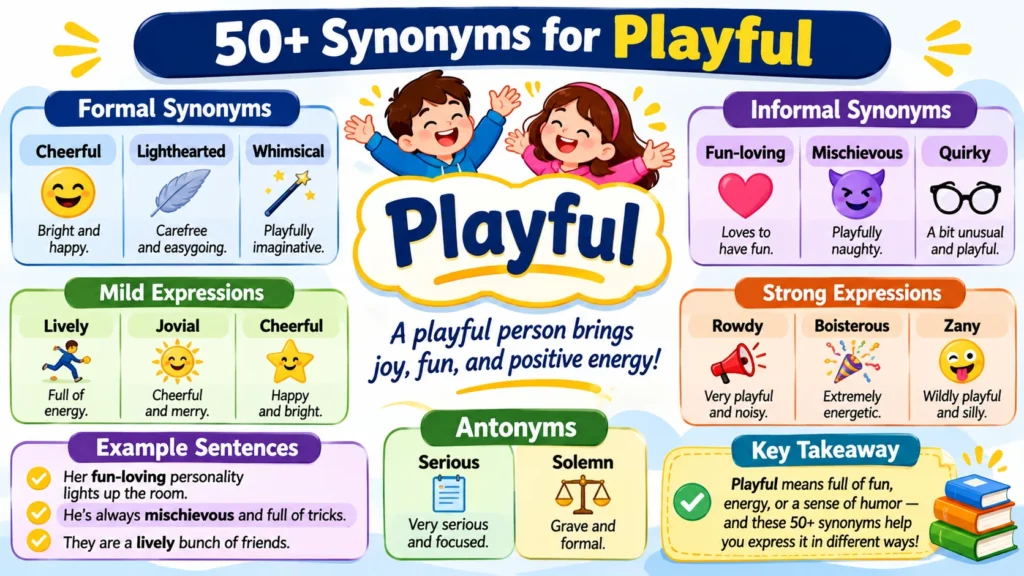
Playful means fun-loving, cheerful, lighthearted, or inclined to joke and enjoy amusing activities. The best synonyms include fun-loving, lively, mischievous, frolicsome, lighthearted, spirited, teasing, whimsical, and jovial, depending on the context.
Have you ever used the word playful repeatedly in an essay, social media caption, email, or everyday conversation? It is a useful word, but sometimes you need something more descriptive to express a person’s personality, a lighthearted mood, a fun atmosphere, or a creative style.
Finding the right synonym for playful can make your writing more engaging and precise. For example, mischievous suggests a little harmless troublemaking, while whimsical describes something imaginative and unusual. Similarly, lighthearted communicates a relaxed mood without necessarily suggesting humor.
Whether you are an English learner, student, professional, writer, or content creator, understanding these differences will help you choose words that fit your message naturally.
Meaning, Tone and Context
What Does Playful Mean?
The word playful describes someone or something that shows a sense of fun, enjoyment, humor, or a desire to play.
It often refers to people who enjoy joking, teasing, laughing, and participating in entertaining activities. It can also describe writing, behavior, conversations, designs, and creative ideas.
For example, a playful person might make a harmless joke during a conversation to make everyone smile.
Part of Speech
Playful is an adjective. It describes a noun, such as a person, personality, expression, attitude, mood, or activity.
Examples:
- She has a playful personality.
- His playful comments made everyone laugh.
- The puppy displayed playful behavior.
Tone and Connotation
Playful generally has a positive or neutral meaning.
- Positive: Suggests happiness, friendliness, humor, and enjoyment.
- Neutral: Describes a fun or informal attitude without strong emotional meaning.
- Potentially negative: Can suggest teasing or childish behavior when the situation calls for seriousness.
Formality Level
Playful is a versatile word that works in both formal and informal English.
It is appropriate for everyday conversations, creative writing, product descriptions, marketing, and professional communication when a friendly tone is suitable.
Common Use Cases
You can use playful to describe:
- Personality: Someone who enjoys joking and having fun.
- Relationships: Friendly teasing or affectionate behavior.
- Writing: A humorous, creative, or entertaining writing style.
- Design: Colorful, imaginative, or unconventional visual elements.
- Communication: A lighthearted message or amusing conversation.
- Animals: Energetic behavior involving games and movement.
Related Word Forms
| Word | Part of Speech | Meaning |
| Playful | Adjective | Showing enjoyment, fun, or humor |
| Playfully | Adverb | In a fun or teasing manner |
| Playfulness | Noun | The quality of being playful |
| Play | Noun or verb | An activity or action involving enjoyment |
| Playmate | Noun | Someone who plays with another person |
When and How to Use “Playful”
Use playful when you want to describe behavior, communication, or an atmosphere that feels fun, cheerful, imaginative, or amusing.
The word is especially useful when the situation is friendly rather than serious.
Here are seven realistic examples.
1. Personal: Her playful personality makes her easy to get along with.
2. Professional: The designer used playful colors to make the presentation more engaging.
3. Academic: The author adopts a playful writing style to make the subject accessible.
4. Romantic: He gave her a playful smile when she entered the room.
5. Social Media: I love the playful energy of this picture.
6. Email: We could introduce a playful element into the campaign to make it more memorable.
7. Creative Writing: The story combines playful dialogue with imaginative characters.
Another Word for “Playful”
The best single replacement for playful depends on what you want to communicate.
Fun-loving is one of the closest everyday alternatives because it describes someone who enjoys fun and entertainment.
However, other words may be more accurate in specific situations.
| Situation | Best Alternative | Why It Works |
| Professional writing | Lighthearted | Communicates a friendly, relaxed tone |
| Academic writing | Whimsical | Describes imaginative or unusual qualities |
| Casual conversation | Fun-loving | Sounds natural and approachable |
| Emotional writing | Cheerful | Emphasizes happiness and positivity |
| Creative writing | Imaginative | Highlights creativity and originality |
| Resume | Engaging | Describes an approachable communication style |
| Social media captions | Quirky | Adds personality and individuality |
| Stronger meaning | Mischievous | Suggests playful troublemaking |
| Softer meaning | Lighthearted | Suggests gentle humor and ease |
Best overall recommendation: Choose fun-loving for a person’s personality, lighthearted for a mood, mischievous for teasing behavior, and whimsical for imaginative creativity.
When Not to Use “Playful”
Although playful is a flexible adjective, it does not work equally well in every situation.
Sometimes, a more specific word communicates your meaning more effectively.
Here are five situations where another word may be better.
1. During serious discussions: Calling someone’s behavior playful may sound dismissive when they are being irresponsible. Use immature or inappropriate if that is what you mean.
2. In formal reports: Playful may sound too informal when describing a professional personality. Consider approachable or engaging.
3. When describing creativity: Playful may not fully communicate originality. Use imaginative or inventive.
4. When describing mischievous behavior: Playful may sound too gentle. Use impish or mischievous when someone enjoys harmless troublemaking.
5. When describing happiness: Playful does not always mean happy. Use cheerful, joyful, or jovial when happiness is the main idea.
Choosing a more precise synonym helps readers understand exactly what you mean.
Words Commonly Confused With “Playful”
Several English adjectives are closely related to playful, but they communicate different qualities.
| Word | Meaning | Difference From Playful |
| Funny | Causing laughter | Focuses on humor rather than enjoyment of play |
| Silly | Lacking seriousness or showing foolish humor | Can suggest childish behavior |
| Cheerful | Noticeably happy and positive | Focuses on mood |
| Mischievous | Enjoying harmless troublemaking | Suggests teasing or naughty behavior |
| Whimsical | Imaginative, unusual, or fanciful | Focuses on creativity |
| Flirtatious | Showing romantic or sexual interest | Adds romantic intention |
For example, someone can be cheerful without being playful. Similarly, a funny person might make jokes without having a particularly playful personality.
Understanding these distinctions helps you avoid choosing synonyms that change your intended meaning.
Best Synonym by Context for “Playful”
The most suitable synonym depends on whether you are describing a person’s personality, an activity, a mood, or a communication style.
| Context | Best Synonym | Why It Works | Example |
| Formal writing | Lighthearted | Sounds polished and natural | The event maintained a lighthearted atmosphere. |
| Academic writing | Whimsical | Describes imaginative expression | The author uses whimsical imagery. |
| Professional communication | Engaging | Suggests appealing interaction | Her engaging presentation attracted attention. |
| Resume | Approachable | Highlights friendly communication | Maintained an approachable communication style. |
| Casual conversation | Fun-loving | Describes someone who enjoys fun | My brother is incredibly fun-loving. |
| Creative writing | Imaginative | Emphasizes originality | She created an imaginative character. |
| Emotional expression | Cheerful | Highlights happiness | His cheerful personality brightened the room. |
| Strong intensity | Mischievous | Suggests harmless troublemaking | The mischievous child hid the cookies. |
| Soft or moderate tone | Good-humored | Suggests friendly humor | She responded in a good-humored way. |
| Social media captions | Quirky | Adds personality | Keeping life quirky and colorful. |
| Romantic communication | Teasing | Suggests affectionate joking | He sent a teasing message. |
| Animal behavior | Frolicsome | Describes energetic play | The frolicsome puppies chased each other. |
| British English | Cheeky | Suggests playful boldness | He gave me a cheeky grin. |
A Note on US and UK Usage
Most synonyms for playful are understood in both American and British English.
However, cheeky is especially common in British conversational English. In American English, mischievous, sassy, or teasing may sound more familiar depending on the situation.
Which Synonym Should You Choose?
Choosing the right synonym becomes easier when you consider five things.
1. Identify the exact meaning.
Are you describing humor, imagination, friendliness, energy, or teasing? Choose a word that expresses the specific quality.
2. Consider formality.
Use lighthearted or engaging in professional writing. Choose goofy, quirky, or fun-loving in relaxed conversations.
3. Check the emotional intensity.
Cheerful sounds positive and gentle, while mischievous suggests a stronger sense of playful troublemaking.
4. Think about your audience.
A word that works in a social media caption may not be appropriate in an academic essay or business report.
5. Read the complete sentence.
A synonym should fit naturally into the sentence without changing its original meaning.
The best word is not necessarily the most sophisticated one. It is the one that communicates your intended message clearly.
Real Life Examples of “Playful” in Sentences
Here are practical examples showing how to replace playful with more descriptive alternatives.
| Situation | Example Sentence |
| School | The teacher used a whimsical activity to make the lesson interesting. |
| Workplace | Her engaging communication style encouraged team participation. |
| Academic writing | The author uses imaginative descriptions throughout the novel. |
| Conversation | My best friend has a fun-loving personality. |
| Social media | Bringing some quirky energy to the weekend. |
| Resume | Demonstrated an approachable and engaging communication style. |
| I appreciate your lighthearted approach to the project. | |
| Storytelling | The mischievous character constantly surprised the other villagers. |
| Relationships | She gave him a teasing smile across the table. |
| Animal behavior | The energetic puppy enjoyed chasing its favorite ball. |
25 Synonyms for “Playful”
| Synonym | Simple Meaning | Best Used For | Example Sentence |
| 1. Fun-loving | Enjoying fun and entertainment | Personality | She is a fun-loving person who enjoys adventures. |
| 2. Lighthearted | Relaxed and cheerful | Mood | We had a lighthearted conversation after lunch. |
| 3. Mischievous | Enjoying harmless trouble | Behavior | His mischievous grin gave away the surprise. |
| 4. Frolicsome | Full of energy and fun | Animals and activities | Frolicsome puppies ran around the garden. |
| 5. Lively | Full of energy and enthusiasm | Personality | Her lively attitude made the gathering enjoyable. |
| 6. Spirited | Energetic and enthusiastic | Personality | The spirited child never ran out of ideas. |
| 7. Cheerful | Happy and positive | Mood | He maintained a cheerful attitude throughout the day. |
| 8. Whimsical | Imaginative and unusual | Creative writing | The book features whimsical illustrations. |
| 9. Jovial | Friendly and cheerful | Social situations | Our jovial host welcomed every guest. |
| 10. Teasing | Gently making fun of someone | Relationships | She gave him a teasing look. |
| 11. Impish | Slightly naughty in an amusing way | Personality | The impish boy hid his sister’s shoes. |
| 12. Quirky | Unusual in an interesting way | Style and personality | Her quirky fashion choices stand out. |
| 13. Amusing | Entertaining or funny | Writing and conversation | His amusing story made everyone laugh. |
| 14. Humorous | Expressing or producing humor | Communication | She added a humorous comment to the speech. |
| 15. Good-humored | Cheerful and friendly | Professional and personal | He remained good-humored during the meeting. |
| 16. Animated | Full of visible energy and expression | Conversation | She became animated while discussing her favorite movie. |
| 17. Vivacious | Full of life and enthusiasm | Personality | Her vivacious personality attracts new friends. |
| 18. Bubbly | Cheerful and energetic | Casual descriptions | My bubbly coworker always greets everyone warmly. |
| 19. Gleeful | Showing great happiness | Emotional expression | The children gave a gleeful cheer. |
| 20. Frisky | Energetic and eager to play | Animals and people | The frisky kitten jumped onto the sofa. |
| 21. Comical | Funny in an amusing way | Entertainment | His comical expressions made the audience laugh. |
| 22. Sportive | Fond of sports or playful activities | Physical activities | The children enjoyed a sportive afternoon outdoors. |
| 23. Buoyant | Cheerful and optimistic | Emotional tone | Her buoyant attitude lifted everyone’s spirits. |
| 24. Droll | Amusing in an unusual or dry way | Literary humor | His droll observations entertained the readers. |
| 25. Cheeky | Bold in an amusing or slightly disrespectful way | British conversation | He made a cheeky remark about the situation. |
Synonym Groups and Usage Differences
Different groups of synonyms communicate different shades of meaning. Understanding these categories makes it easier to select an appropriate word.
Professional vs. Personal Synonyms
Professional alternatives:
- Engaging
- Approachable
- Lighthearted
- Good-humored
- Animated
Personal alternatives:
- Fun-loving
- Mischievous
- Bubbly
- Quirky
- Cheeky
Example:
Professional: Her engaging presentation encouraged audience participation.
Personal: My fun-loving sister makes every family gathering entertaining.
Formal vs. Conversational Synonyms
Formal alternatives work better in reports, presentations, professional emails, and structured writing.
| Formal Synonyms | Conversational Synonyms |
| Lighthearted | Fun-loving |
| Whimsical | Goofy |
| Good-humored | Cheeky |
| Engaging | Bubbly |
| Imaginative | Quirky |
For example, lighthearted sounds appropriate in a workplace report, while goofy is more natural when describing a funny friend.
Academic Synonyms
In academic writing, choose words that communicate a specific characteristic rather than simply replacing playful with another adjective.
Useful options include:
- Whimsical: For imaginative or unusual creative elements.
- Imaginative: For original ideas and creative thinking.
- Humorous: For content that intentionally creates amusement.
- Lighthearted: For a relaxed or cheerful tone.
- Amusing: For something that entertains readers.
Example:
Instead of writing, “The author uses playful language,” you could write, “The author uses humorous language to maintain the reader’s interest.”
Professional and Business Synonyms
In professional communication, playful can sometimes suggest an overly casual attitude.
The following alternatives may communicate the intended quality more effectively.
| Alternative | Professional Application |
| Engaging | Presentations and meetings |
| Approachable | Leadership and teamwork |
| Lighthearted | Friendly workplace communication |
| Imaginative | Marketing and creative projects |
| Innovative | New ideas and business solutions |
| Good-humored | Positive workplace relationships |
For example, a resume could describe someone as having an approachable communication style rather than simply calling them playful.
Use innovative only when you mean originality or new ideas, not merely a fun personality.
Creative or Literary Synonyms
Creative writing benefits from words that communicate personality, atmosphere, and imagination.
Consider these alternatives:
- Whimsical
- Impish
- Frolicsome
- Droll
- Quirky
- Mischievous
- Vivacious
Example:
“The mischievous fox slipped through the garden while the villagers slept.”
This creates a more specific impression than simply saying, “The playful fox entered the garden.”
Slang or Modern Synonyms
Some casual expressions can replace playful in everyday conversations, although they are not always exact synonyms.
| Word or Expression | Meaning | Best Context |
| Goofy | Silly and funny | Friends and casual conversations |
| Cheeky | Boldly amusing | British English |
| Sassy | Confident and slightly bold | Casual personality descriptions |
| Wacky | Unusual and funny | Informal creative descriptions |
| Silly | Not serious, often amusing | Everyday conversation |
Example:
“That was such a goofy idea, and somehow it worked!”
Avoid using these expressions in formal reports or academic writing unless the subject specifically requires an informal tone.
Strongest vs. Weaker Synonyms
Not every synonym has the same emotional intensity.
Here is a practical scale showing how some related words differ in strength.
| Intensity | Word | Description |
| Mild | Good-humored | Gently friendly and humorous |
| Mild | Lighthearted | Relaxed and cheerful |
| Moderate | Cheerful | Clearly happy and positive |
| Moderate | Lively | Energetic and active |
| Strong | Spirited | Highly enthusiastic |
| Strong | Mischievous | Enjoys harmless trouble |
| Strong | Impish | Playfully naughty |
| Strong | Frolicsome | Energetically playful |
This is a contextual guide rather than a strict dictionary ranking. A word’s intensity can change depending on the sentence.
Emotional vs. Neutral Synonyms
Some synonyms add emotional warmth, while others simply describe observable behavior.
Emotionally expressive:
- Gleeful
- Vivacious
- Bubbly
- Cheerful
- Jovial
More neutral or descriptive:
- Imaginative
- Animated
- Engaging
- Humorous
- Quirky
For example, gleeful suggests visible happiness, while animated describes energetic expression without necessarily indicating happiness.
Antonyms of “Playful”
Antonyms are words that express an opposite or contrasting meaning.
The opposite of playful depends on whether you are describing someone’s personality, mood, behavior, or attitude.
Here are 15 useful antonyms and contrasting words.
| Antonym | Meaning | Example Sentence |
| 1. Serious | Not joking or playing | She maintained a serious expression. |
| 2. Solemn | Deeply serious or formal | The ceremony had a solemn atmosphere. |
| 3. Stern | Strict and firm | The manager gave a stern warning. |
| 4. Grave | Very serious or concerning | They discussed the grave situation. |
| 5. Dull | Lacking excitement or interest | The presentation felt dull. |
| 6. Gloomy | Sad or lacking cheerfulness | He seemed gloomy after the news. |
| 7. Melancholy | Deeply thoughtful or sad | A melancholy mood filled the room. |
| 8. Reserved | Quiet and restrained | She remained reserved during the gathering. |
| 9. Restrained | Controlled and not expressive | His restrained response surprised everyone. |
| 10. Formal | Following established conventions | They maintained a formal atmosphere. |
| 11. Rigid | Strict and inflexible | The rules were unnecessarily rigid. |
| 12. Stiff | Unnatural or lacking ease | The conversation felt stiff. |
| 13. Unenthusiastic | Showing little interest | He gave an unenthusiastic response. |
| 14. Boring | Not interesting or entertaining | The activity became boring. |
| 15. Humorless | Lacking a sense of humor | His humorless reaction ended the joke. |
Important distinction: Not all these words are direct dictionary opposites of playful. Some describe contrasting qualities depending on context.
For example, serious is a strong opposite when discussing someone’s attitude, while gloomy contrasts with playful when describing mood.
Comparison: Playful vs. Similar Words
Some words look interchangeable at first, but their meanings are slightly different.
Understanding these distinctions helps you write more accurately.
Playful vs. Funny
Main difference: Playful describes a fun-loving or joking attitude, while funny describes something that causes amusement.
Which is stronger? Funny is stronger when the main focus is making people laugh.
Which is more formal? Both work in everyday and professional English, depending on context.
Examples:
- Playful: She gave him a playful smile.
- Funny: She told a funny story.
Playful vs. Mischievous
Main difference: Playful suggests enjoyment and fun, while mischievous suggests a tendency to cause harmless trouble.
Which is stronger? Mischievous has a stronger suggestion of naughty behavior.
Which is more formal? Both are acceptable in standard written English.
Examples:
- Playful: The puppy enjoyed a playful afternoon.
- Mischievous: The mischievous puppy chewed the slippers.
Playful vs. Cheerful
Main difference: Playful describes fun-loving behavior, while cheerful describes a happy and positive mood.
Which is stronger? Neither is universally stronger. Cheerful emphasizes happiness, while playful emphasizes fun.
Which is more formal? Both are suitable for professional and casual writing.
Examples:
- Playful: He made a playful comment.
- Cheerful: He greeted everyone with a cheerful smile.
Playful vs. Whimsical
Main difference: Playful suggests enjoyment or fun, while whimsical suggests imagination, originality, or unusual creative qualities.
Which is stronger? Whimsical is more specific when describing imaginative creativity.
Which is more formal? Whimsical often sounds more literary or descriptive.
Examples:
- Playful: The children enjoyed a playful game.
- Whimsical: The artist created a whimsical painting.
Playful vs. Silly
Main difference: Playful describes a fun-loving attitude, while silly describes behavior or ideas that seem foolish or amusing.
Which is stronger? Silly can sound more childish or dismissive.
Which is more formal? Playful is generally more versatile in professional contexts.
Examples:
- Playful: Her playful personality makes everyone comfortable.
- Silly: We laughed at his silly joke.
Playful vs. Flirtatious
Main difference: Playful means fun-loving or teasing, while flirtatious suggests romantic or sexual interest.
Which is stronger? Flirtatious carries a more specific romantic implication.
Which is more formal? Playful is more neutral and versatile.
Examples:
- Playful: He made a playful remark during lunch.
- Flirtatious: He gave her a flirtatious smile.
Common Phrases and Expressions with “Playful”
The word playful appears in everyday expressions, descriptions, and creative writing.
Here are eight useful phrases and examples.
1. Playful Personality
Meaning: Someone who enjoys fun, jokes, and entertaining activities.
Example sentence: Her playful personality makes every family gathering enjoyable.
2. Playful Smile
Meaning: A smile that suggests humor, teasing, or amusement.
Example sentence: He greeted me with a playful smile.
3. Playful Teasing
Meaning: Friendly joking that is not intended to hurt someone.
Example sentence: Their playful teasing made the long journey more enjoyable.
4. Playful Banter
Meaning: Lighthearted and amusing conversation between people.
Example sentence: Their playful banter kept everyone entertained.
5. Playful Mood
Meaning: A relaxed and fun-loving emotional state.
Example sentence: The children were in a playful mood after school.
6. Playful Energy
Meaning: An enthusiastic and entertaining atmosphere or attitude.
Example sentence: Her playful energy made the event feel welcoming.
7. Playful Gesture
Meaning: An action intended to amuse, tease, or entertain.
Example sentence: He made a playful gesture to get his friend’s attention.
8. Playful Nature
Meaning: A natural tendency to enjoy humor, fun, and lighthearted activities.
Example sentence: Despite his serious job, he has a playful nature.
Common Mistakes to Avoid
Even though playful has many synonyms, replacing it without considering context can change your sentence’s meaning.
Here are seven common mistakes to watch for.
1. Using a vague synonym when a precise word is available.
Incorrect choice: Calling every fun-loving person funny.
Better choice: Use fun-loving for someone who enjoys entertainment and funny for someone or something that causes laughter.
2. Confusing playful with flirtatious.
Playful teasing does not always suggest romantic interest.
Use flirtatious only when the behavior communicates romantic or sexual interest.
3. Using casual expressions in formal writing.
Words such as goofy, wacky, and cheeky may sound too informal in academic essays.
Choose lighthearted, engaging, or imaginative when appropriate.
4. Choosing an overly dramatic synonym.
Calling a cheerful person mischievous may suggest that they enjoy causing trouble.
Use cheerful when you simply mean happy and positive.
5. Repeating playful too frequently.
Using the same adjective in every paragraph can make writing feel repetitive.
Replace it with suitable alternatives such as lively, lighthearted, whimsical, or fun-loving.
6. Ignoring emotional tone.
Gleeful, mischievous, and reserved communicate very different qualities.
Check whether your intended message is positive, humorous, teasing, or neutral.
7. Using slang in academic or professional writing.
Expressions such as goofy and wacky are suitable for relaxed conversations but may weaken formal writing.
Choose vocabulary that matches your audience and purpose.
FAQs
1. What Is the Best Synonym for Playful?
Fun-loving is one of the best general synonyms for playful, especially when describing personality. Lighthearted, mischievous, and lively are useful alternatives for specific contexts.
2. What Is a Formal Synonym for Playful?
Lighthearted is a suitable formal alternative when describing a relaxed mood or friendly atmosphere. Engaging and imaginative also work in appropriate professional contexts.
3. What Is an Informal Synonym for Playful?
Goofy, fun-loving, cheeky, and quirky are informal alternatives. They work well when describing friends, personalities, funny situations, or casual conversations.
4. What Is Another Word for Playful in Professional Writing?
Engaging, approachable, lighthearted, and good-humored can replace playful in professional writing, depending on whether you are describing communication, personality, or atmosphere.
5. What Is the Difference Between Playful and Mischievous?
Playful describes fun-loving behavior, while mischievous suggests enjoying harmless troublemaking. Someone can be playful without necessarily being mischievous.
6. What Is the Opposite of Playful?
Serious is one of the most suitable opposites of playful. Other contrasting words include solemn, stern, restrained, humorless, and gloomy.
Conclusion
Finding the right synonym for playful can make your vocabulary more expressive and your writing more engaging. Words such as fun-loving, lighthearted, mischievous, whimsical, cheerful, and lively each communicate a slightly different quality.
The key is to consider your audience, writing purpose, and intended tone before choosing an alternative. Use professional words such as engaging in workplace communication, imaginative in creative writing, and fun-loving in everyday conversations.